When we’re launching a show, it’s easy to assume the website is the big move.
A website feels official. It feels like progress. It feels like the thing that makes the project “real.”
And yes — a great website is cool.
This post is about a faster path: the path that gets tickets sold sooner, keeps our energy clean, and gets the tech stuff off our plate.
This advice comes from producing a weekly show for 266+ weeks and helping performers sell themselves for a living. I’ve built a lot of websites. I’ve also watched websites become a distraction from the one thing that matters: getting people into seats.
Websites Work Best as Conversion Tools
A website is not a stranger machine.
A website works best when it takes someone who’s already curious and turns them into someone who clicks Buy.
That’s the job.
So when we’re building a new show, the question becomes:
What helps a curious person buy a ticket with the least friction?
Strangers Come From Promotion
If we want new people in the room, they don’t appear because we built a nice page.
They show up because we promote.
Strangers come from:
ads
flyers / physical presence
partnerships
venues and local orgs sharing us
word of mouth
social momentum
being talked about by the right people
That’s the engine.
The Fastest Setup Is a Short Funnel
When our goal is ticket sales, we win by making the funnel short.
The best setup looks like this:
Promo → Simple page → Ticket button → Checkout
That’s it.
Step 1: Put Ticket Sales on a Ticket Platform
We pick a ticket platform and let it do what it’s built to do.
Eventbrite. Humanitix. TicketTailor. Anything.
This is where we host:
dates
ticket tiers
seat options
checkout
confirmation messages
receipts
This keeps everything dependable.
It also makes it easy for other people to share our show, because the link behaves like a real product.
Step 2: Put One Simple Webpage in Front
Then we buy a domain and put up one clean page.
That page can be wildly simple:
our poster / key artwork
1–2 sentences about the experience
address
dates
a big BUY TICKETS button
That’s the whole site.
This is enough for 95% of our customers.
They don’t need an essay. They need clarity. They need confidence. They need an easy button.
This Lets Us Launch This Week
This is the superpower of the one-page approach:
Speed.
We can be live this week.
And once we’re live, every promo effort has a clean destination:
a link we trust
a page we control
a button that works
Then we can put our attention where it belongs: filling seats.
What About the People Who Want the Schedule?
Some people want to follow our schedule like it’s their favorite TV show.
They’re rare and magical.
For those people, our best move is:
social media follow
email list
text list
That’s where repeat attendance comes from.
That’s also how we build a community around the show.
The One-Page Site Is the Perfect “Now” Move
Once the show is running and momentum is happening, we can absolutely expand into:
cast bios
photo galleries
embedded trailers
deeper storytelling
an immersive long-scroll experience
press kits and venue inquiry pages
That’s a beautiful upgrade.
For launch season, the one-page site + ticket link gives us something even more valuable:
momentum.
The Goal Is Tickets, Not Tech
We’re building a show.
We’re building a room full of laughing humans.
We’re building an experience that feels electric.
A one-page site and a ticket button gets us there fast.
We know people who are social duct tape. “You HAVE to see this artist” or “I know exactly who you need to talk to.” They see how things fit together and they get excited about making introductions. These people are gold. We can empower them and breed them.
Most people want to refer but they’re calculating the cost. They need to figure out the technology of Yelp or whatever platform. They might need to reach out to people they’ve been putting off talking to. They need the right words. And they’re risking their reputation as a curator and human being. That’s a lot.
Here’s what actually works: Show everyone how all three people win, make it easy, and show them we’ll treat their referral right.
The natural referrers already get it. When they refer an artist, they’re thinking:
Their friend gets to have the same experience they had
The artist gets a well-deserved fan who’ll appreciate their work
They look philanthropic to the artist and knowledgeable about secret underground talent to their friend
Three wins. That’s the referral engine.
Make the wins obvious. At Boobietrap, I tell everyone we have 5 stars on Yelp. Someone might think “I like this weird show, but I don’t know if my friends will.” They hear everyone likes it and suddenly a recommendation feels safer. All three wins become clear.
Show love to everyone. People see we care about our customers and they trust we’ll take care of their referrals. Confident putting their reputation on the line because they know we’ll do good stuff with it.
Make it stupid easy. Lower the cost of referring. Simple link to share. Pre-written text they can copy. No complicated sign-up process for their friends.
Tell them what matters. Don’t make people figure out what to say. Help them focus on what’s important. “I would love for you to tell a friend that this magic show was great for short attention span people.” Or “I’m pumped that you thought what I did was a low-priced version of the LA Orchestra. Could you tell someone that?” Give them the language that captures what made their experience special.
Be clear about what we do and who it’s for. “I love connecting with parents who are way too busy with life to plan their kids’ whole birthday party.” When people understand exactly who benefits from what we do, they can spot the perfect referral in their own network. They’re not guessing if their friend would like it. They know.
The math is simple. Most businesses try to create referrals with discounts or commissions. The people who naturally refer are motivated by looking smart, helping their friends, and making good connections happen.
Triple-win visibility + trust + ease + clear language = referral machine that runs itself.
Scot Nery’s Boobietrap (returning this year) became the #1 show in LA, toured the west coast, won awards, worked with over 700 performers, and happened every wednesday no matter what for nearly 300 performances. Here’s how I stayed organized (ish).
YOUR MIND OR YOUR CAREER
A friend of mine has skipped responding to multiple emails just because he can’t easily find a working resume.
If you’re ADD and bipolar with chronic anxiety like me, you’ll probably want to have some fun! Ever missed a callback because you couldn’t find the right headshot? Lost a networking opportunity because their business card disappeared into the void?
If you’re not like me, you probably still realize the awesomeness of getting decluttered. There are lots of tools i’ve set up to deal with my cluttered lists, files, objects, and thoughts. Gives me the freedom to have fun and to *notice* that i’m having fun.
I GOT HELP
I’m learning a lot about how to organize things and keep up with many of my stuffs. The thing that has helped me the most is THE PLOP. David Allen introduced me to good todo lists; Ethan Schoonover to folder management. Both had a place to put weird stuff immediately.
The thing i learned is to have homes for everything including a home for the homeless things. That temporary shelter is what I call “plop.” Thought you might get inspiration from my categories of things to keep organized.
HOMES
1️⃣ FAST: things I need access to regularly Physical: my performance costume Digital: current project files Mental: today’s priorities
2️⃣ SLOW: things I want to keep but rarely need Physical: juggling props that i only use for special gigs Digital: past demo reels I’ve archived Mental: my dream project ideas
3️⃣ COMMUTE: things that are moving around Physical: my goodwill donation bag Digital: files I need to upload Mental: partial messages for collaborators
4️⃣ PLOP: stuff that doesn’t have a home yet Physical: Amazon packages I just got Digital: random screenshots I took Mental: “should I call that director?”
5️⃣ LIBERATE: trash, recycle, curb, email archive
FIND THE GOOD IN LIFE
Plop is crucial because it gets stuff out of my head and out of my line of sight so i can stay focussed. This means having an apple note on my phone called plop. That’s where i put tasks, thoughts, partial notes etc. I have a folder on my computer called plop. That’s where I put downloads and email attachments i’ll need to file or delete later. I have several spaces in my house / garage for plopping stuff immediately so they’re out of my way.
The final step of #ploplife is to clean up regularly. 80% of plopped things can probably be liberated, so I go thru it every once in a while (sometimes daily, sometimes much less often). Tasks that seemed urgent at 2am like “eat that banana” are easy to delete a week later when the banana is very mooosh.
It feels good when my plop is clear. Cleaning it up is the difference between plop and a junk drawer. Junk drawers are a permanent home for junk.
APLOPALYPSE NOW
step 1: put a bunch of stuff that’s out of place in one place. eg: clear off a desk and put all of the stuff in a box.
step 2: put on your todo list “clear plop”
step 3: when you get around to it, take things out of the plop, make a todo list item of them (eg: “repair my hat”) , put them in their home, make a new home for them.
YOU’RE NORMAL FOR A WEIRDO
I got tired of my friends not having websites because they had to organize their files. When i make a website for someone, I just take all the organizing off their hands for them. That’s what makes my process so fast. I have my dude scrape the internet for everything about a customer. I don’t wait for them to find their resume or photos.
When I’m someone’s action partner, usually the first thing we need to do is get organized. it’s a relief for me to know that nearly everyone is a mess in some way.
Having a clear head and being able to access my resources is a game changer for me. It’s taken me around the world. It’s made me the person people call first when they’re looking for interesting performers. It’s given me energy and engagement with my family.
PS: Oh, i’m also paralysingly obsessive and a recovering perfectionist!
There’s a thing in sales called “talking past the sale” the person already wants to buy, then the sales person keeps talking and ends up talking the customer out of a good decision.
That’s just one reason to keep websites simple.
The two main people we want to serve with a gig-getting website is a person who wants to buy and is checking for red flags (Justin) and a person who wants to refer us (Casey), and just needs a tool or content to send to their friend.
We want to give both of these people only the good stuff and get them into action.
RED FLAGS
Justin will do as much as he thinks he’s supposed to to be cautious and prudent. If he feels he must look at every thing on your website to make sure he doesn’t miss anything… great. We’re trying to prevent him from getting any red flags. A simple red flag could be that show how creative and imaginitive and how much of a bold artist i am and Justin assumes that that means i’m an artist who does things their own way. I might not show up on time, i might not shower, I might say something political or irresponsible.
Everything carries possible baggage and possible red flags. So, we keep it short and to the point and we’re good. We’re not responsible for getting everything spotless for Justin. Justin is not responsible for reading 7 pages of content carefully and figuring out what it means. We can say, “Sounds fun,” and shake hands.
TOOLS FOR REFERRAL
We want to have the best tools for referral possible for our friends. Casey is trying to make a mutually beneficial connection. She wants an easy way to say, “Hey! Scot’s good” We put that up front and center and casey can click in, get the good stuff and copy and paste it, or share the site. If we give Casey every article about us that’s ever been written, she might not send the good one over. She might get confused about how to sell us.
FOCUS
When Justin and Casey are hunting through our sites, they could be on a long journey until a tab get’s opened up in front of our site. They get pulled away and they don’t take the action. They might not see our tab again until they’re busy or the gig is in the past.
Let’s get them to understand the value, then take action immediately and get it off their plates for them.
We also want to focus our offering. We are specialists. Specialists are more valuable. Specialists get respect. Specialists are able to create transformation. The more information we add to the website, the more general we seem.
SINGLE PATH
Let’s keep Casey and Justin chugging along on one track that takes them exactly to the desired action. Trust me, they want to get it done too. They want us to be successful and they want it to be easy for them. If we give them links out to other things including our social media, they may go. Then, it’s up to them to come back and do the action.
If there’s a quote from an article that Casey absolutely must copy and paste, then put that quote on the site. Edit it down to the essential part. If our social media is rocking and we have 200k followers and we think Justin will like that, write on the website “200k followers!” That’s easy.
Let’s keep it short. Let’s make it easy for Justin Case
It sounds like a big opportunity… sometimes it is.
I’ve helped with casting for these companies
I’ve been on a lot of TV shows and helped other performers get on a lot of tv and film stuff.
Exposure is the trade they’re offering
Most people go on these shows chasing one thing: exposure. Here’s what that actually looks like:
A clip of you performing in front of millions of people
A chance to get noticed by bookers or fans
Credibility if the show has name recognition
Something to post and point to when people ask “Where have you performed?”
That can be enough to move your career forward—if you use it right.
You lose control the second you walk onstage
What they don’t tell you up front:
You don’t own the footage. They do.
You don’t control the edit. They can cut it however they want.
You don’t decide the story. They often cast you as a type: the underdog, the weirdo, the one who cries.
If you’re cool with being entertainment, fine. But if you want your act to speak for itself, this isn’t always the way.
Certain performers can use this as a shortcut
Some people really benefit from going on these shows. You might be one of them if:
You don’t have a professional clip of your act and want a good one
You’re great live but haven’t figured out how to showcase it online
You’re breaking into a new market (e.g., you’re known locally but want to go national)
You’ve got a weird or visual act that doesn’t translate well in print or photos
Other performers should probably stay away
You might want to skip it if:
You already have a strong portfolio and pro footage
You rely on surprise or mystery—once your act airs, that trick’s burned
You want full control over how you’re presented
You’re hoping to win (spoiler: you probably won’t)
These are the real pros and cons
PROS
Free national exposure
Fast, high-quality clip
Can boost your bookings short-term
Gives you a story to tell and credibility
Chance to surprise people who underestimated you
a new logo on your resume
CONS
You give up control of your act and image
They can make you look like a joke
You don’t own the footage
You can’t reuse your signature act as easily
Low odds of winning anything
Winning isn’t the real win
The people who “win” these shows usually aren’t the ones who go the furthest in real life. Use the show as a tool. Go in with a plan. Know what you want out of it. Take the part that helps you
A professional web presence builds long-term success
If you want a career—not just a TV moment—make sure people can find you, trust you, and book you easily. A real website, a clear pitch, and a smooth booking process will do more for your life than waiting for your golden buzzer.
I help magicians and variety performers get that part handled. Clean, fast, no BS websites built around how you actually get gigs. I can most likely zoom with you for 1 hour. You prepare absolutely nothing and you have a website in a few days.
We entertainers often look like we’re out of business online. Old show posters and schedules haunt our social media pages, making it seem like we quit months ago.
Social media is the perfect place for flyers and show announcements—easy to update, quick to change. Websites, not so much. They confuse and distract bookers looking for clear info, so we keep our gig details on Instagram or Facebook.
If we stop posting fresh content, those old flyers make our careers look stale and inactive. Visitors won’t assume we’re busy elsewhere; they’ll think we have no gigs at all.
Here’s the simple fix:
Prune regularly. After each event passes, delete outdated show posts.
Stay current. Keep only recent highlights or evergreen content on the feed.
Schedule cleanups. Once a month, remove outdated flyers or event posts.
Fill gaps smartly. If new shows are rare, post backstage snaps or short updates to show we’re active.
Regular pruning prevents our social media from looking dead, keeps bookings flowing, and clearly communicates we’re alive and thriving.
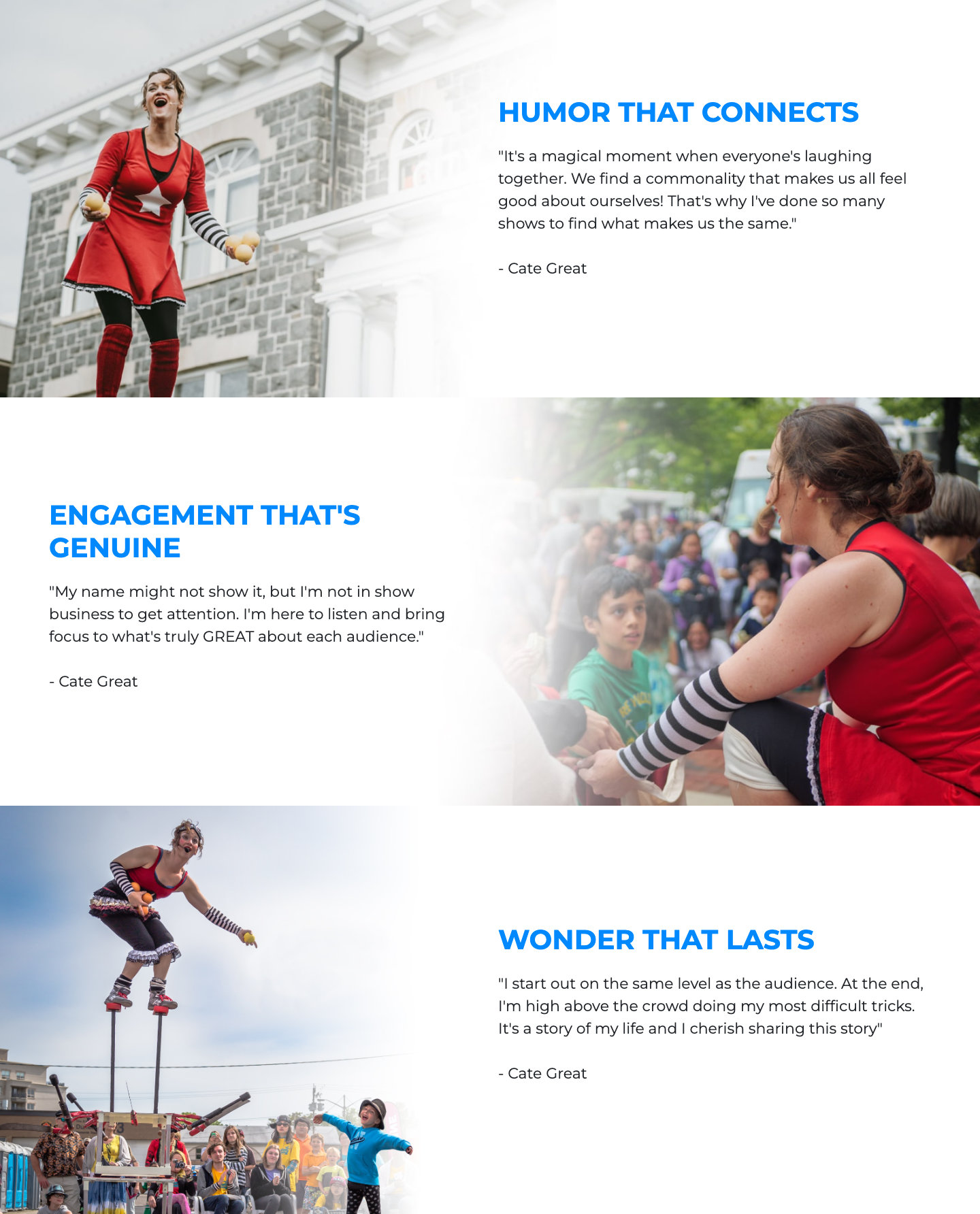
Usually when i make one of these it’s a zig zag. in the first section on desktop, there’s a photo on the left with text on the right. Below that, text on the left and image on the right. Back and forth like a cascading zig zag.
The point is to give a little more clarity about what the thing is, how it works and reinforce the value proposition (as we do with everything else on the page)
Here are some examples from diffferent times in my life. Some of theses zigzags are more successful than others 😀
Selling merch is not very rewarding unless we’re doing a ton of shows. We buy merch for reasons.
Occasionally the merch has value in itself—disconnected from the performance or brand (like a comedy album).
We usually buy merch because we want to remember an experience, to be part of something bigger, and so that others recognize that we’re part of a certain tribe. We want to start conversations about something ongoing that we love. That means if we have a one-off show that isn’t a consistent event for a tribe of people—or if it’s not backed by a big brand—merch may become an expensive investment.
Getting merch right takes a lot of money, time, experimentation, and a significant amount of empathy and energy. It also requires storage and transport. For example, with shirts, we have to stock plenty of every size. Even posters, which come in heavy bulk, must be stored flat.
Then, we have to be ready with a point of sale system and possibly staff a merch booth that’s open before and after the show. We would advise getting merch made only when it is obvious that it will provide a significant boost in profits.
Making T-shirts for the cast and crew is a different matter. That can be fun and serves as a less expensive way to show our appreciation to those whom we might only be able to pay a small amount.
Productivity / Mindset – Stay focused, manage our time well, and build habits that keep our work moving forward without burnout. Stop kicking our own butts.
Health – Take care of our bodies and minds so we have the energy and clarity to create and perform at our best.
Value Creation – Develop unique, high-quality work that solves problems or delights our audience. Humanity needs us.
Value Delivery – Make sure our work reaches clients in a way that’s professional, seamless, and leaves them thrilled.
Sales – Learn how to confidently communicate our worth and close deals that pay us what we’re worth. Pricing, negotiation, honesty, love.
Marketing – Get the right people to notice and trust us, so they’re excited to hire or support us. Attention that’s useful.
Finance – Handle our money wisely so we can stay in business, grow, and create without financial stress.
These are based on the five parts of a business plus the two things that individuals also need. This means we can have one per day.
I have switched over to 100% meal replacement shakes and I might never switch back to food.
I’m writing this because…
i want to get all my thoughts in one place about it
I know that many great creators who read this want to be able to dedicate more of themselves to their creativity
I want a shortcut when someone asks me about this
I’m pumped about technology and still I’m a late adopter. I like things to work well and be effective for what I need. I feel that shakes are this.
I might do alcohol and food sometimes to have some fun with people. It will come with the cost of feeling worse.
The cost of food
here are some things i’ve noticed i can cut out…
✁ Mood fluctuations
✁ Cooking
✁ Cleaning
✁ Shopping
✁ Food waste
✁ Eating animal products
✁ Thinking about nutrition ( including counting calories, balancing macros )
✁ Making food choices
✁ Meal breaks
✁ Listening to cravings
✁ Energy spikes
✁ Diet regret
✁ Nearly all trash
If my family joined me in this journey, we could cut out…
✁ dishwasher (hand washing is easy)
✁ stove
✁ refrigerator
✁ airfryer
✁ microwave
✁ pantry
✁ pans, dishes, etc
✁ basically, a whole room of the house
Probably saving me about 90 min a day of time.
I don’t have to dedicate time to sitting down at a meal. I can drink a shake while I’m in a meeting. It would be kinda disrespectful to have a salad.
Probably reducing my depression and anxiety by 40% to 70% from where I was ( i have other tools that help me with a lot of dep+anx)
The cost of shakes
2000 calories per day is $53 / week for Huel Essential. I get a box of powder and mix it with water. I started with Soylent ($69 / week… nice) they had supply chain issues, so i switched to Huel.
*I like the taste of both for all day drinking. Soylent is more chemically tasting and Huel is more chunky (like cereal milk)*.
Shakes cost me the short pleasure of chewing something interesting. My sense of smell is intense.
The powder travels well, but if I don’t plan it out, i’ll be back to eating food – which i did during Christmas and Wildfire evacuations. Lack of sleep + no shakes leads me to eating a little yucky. I tried to drink a half a day worth of soylent before a flight and I was very disappointed! Felt dizzy and like i was going to puke for a few minutes.
The social cost is lower than I expected. Most of our family meals are asynchronous. When they happen, and I was eating food, I would eat faster than everyone else and watch them eat anyhow. People do want to talk about it a lot, that’s part of the reason I’m writing this.
UPDATE 2025-04-24
🔹 SHAKE & MIX-INS
Huel Essential (3 bags for $100) $8.33
Soy Protein Isolate $0.74
Chia Seed Powder $0.43
Ground Flaxseed $0.09
Creatine Monohydrate $0.14
Choline Bitartrate (500g) $0.04
Potassium Citrate $0.04
Calcium Citrate $0.05
Sea Salt $0.01 (approx)
Subtotal (Shake & Mix-ins) $10.87
🔹 SUPPLEMENTS
Magnesium Glycinate | $0.15
Zinc Picolinate | $0.08 | |
Vitamin B12 (3–4x/week avg) | $0.04 | |
Omega-3 (EPA/DHA) | $0.45 | |
Vitamin D3 + K2 (every other day)| $0.20 | |
Subtotal (Supplements) | $0.92 |
💰 TOTAL DAILY COST: $10.87 + $0.92 = 🔹 $11.79/day
The health
I’m trying to live a long life and an enjoyable life.
It seems to be healing my foot and eye things I’ve been dealing with for a long time. I am working to lose weight, so the calorie counting is really simple.
2025-01-31 my foot thing was with me for years. it was plantar warts. They’re all gone. anecdotal and coincidental maybe.
My major blood markers are better than before according to my doctor. I’ll probably get more tests done and improve my tracking of health.
As I mentioned, mental stability is better.
Two people asked me about jaw strength. My jaw still works for talking and making facial expressions. When i’ve eaten food, it still works for chewing. Maybe I’m gritting my teeth at night. Somehow my jaw hasn’t fallen off.
Mom asked about teeth. Saliva could be helpful maybe with teeth and digestion. I’ll go to the dentist soon and check that out.
I’ve lost about 10lbs. I attribute this just to the fact that I decided how many calories I needed per day to lose weight at a healthy pace. Then, I calculated how much of the shakes i would consume in a day. Then, I figured out how mix up that much for one day. I don’t have to schedule my meals or keep track. I can drink them any time I want, and when I am out of shake, I know I’ve eaten enough to lose weight, yet maintain health.
2025-03-11 I lost more weight. Got down to my target weight. Now, I’m going to keep losing fat and gain more muscle – strength training is recommended for longevity and I’d like to look more athletic. Weight loss is more than having the right foods, it’s majorly about “Will I do it?” The shakes are a great way for me to make it a low-labor process. It’s like having a nutritionist and a personal chef to me.
I picked Huel Essential because of the macro balance
Coffee and water. I try to drink one cup of water for every cup of Huel. A lot of pee, but keeps me feeling good. I poop less.
A probiotic is recommended, so i might start doing a 1/2 cup of raw sauerkraut every day.
2025-01-31 I’m going to switch to creatine, d & k, Omega, choline, and sauerkraut and see how that works with Huel
2025-03-11 ☝️ that’s the supplement pile i’m using. Going great. ChatGPT said i could possibly notice cognitive improvements from many of the things. I can’t tell. I cut down on the water. I just drink water when i’m thirsty. I was thinking that I was constipated and that’s why i was drinking a lot. Most likely, I think I’m only eating as much as I need, so I don’t need to use the bathroom as much.
2025-03-11 calorie restriction has lead to hunger at night. Like animal hunger. I can go without eating and in the morning, i’m not feeling hungry. I skipped coffee one day and didn’t have that hunger, so maybe i’ll cut out coffee.
☝️ man, this is getting kinda complicated 😀 yet still simpler than going to the grocery store and trying to figure out what peanut butter to buy
The logic
Shakes may not be the perfect food. Even exactly what comes out of the bag I feel is better than I was eating before nutritionally.
I was careful about my diet. Mostly eating lean meat, legumes, veggies and grains. Trying to avoid things that contain sugar and high glycemic index. or more than 12g of sat fat per day. Tried to avoid high sodium foods. I had high blood sugar (pre diabetic), blood pressure, and blood cholesterol at one point.
I would still have one or two days of wildness. So, i might have a bunch
Without will power
Having rules is way easier for me than trying to have will power. I don’t want will power. I want to live long and well.
It is way easier for me when cravings arise several times a day to drink more Huel or water. The question is easy to answer… questions like
do i eat the rest of arlo’s pizza?
am i going out for a drink?
what snacks are around?
how much did i eat today?
how many days did i eat junk food this week?
what are my calories for today?
These questions are pretty boring to me and laborious to answer.
*2025-03-11 the past few days, I ran out of the mix and shipping wasn’t working. I’m going to order extra to be ready for a sitch like this. I ate and drank and I got very depressed. It was shocking how much of an effect it had on me. It might have given me a few cold symptoms too.
2025-03-18 last week, had pizza on a date. it lead to a bunch of candy and stuff later in the day. Maybe it’s a blowback from being so rigid? Maybe it’s just that food is really delicious and crunchy and chewy. I felt emotionally yucky while doing it and worse the next day. I’m getting to be very anti-food. I didn’t notice how much it was affecting me before. I’m not judging people that eat food in any way. Like I wouldn’t judge people who have a palm pilot. I’m grateful I’ve found this technology and I hope others who want it are able to find it too.
State Changes
A growing awareness I have is noticing how much I crave a state change. I want to eat something, drink something, change my environment, move my body etc. This is healthy I guess as long as my state changes are healthy.
I’m noticing my cravings and my temptation to destabilize my body system. Those cravings were probably always there and they go away about as fast as if I indulged.
Staying aware
I am a little suspicious about this tack. My general doctor said it’s probably okay. Nobody’s really recommending it – not even the shake companies (probably to prevent liability). I’m going to keep monitoring stuff and see where it goes.
The major stated downsides to the nutrition of it seem to be
getting dependent on shakes (who cares?)
each individual has different needs, so it isn’t perfectly balanced ( am i still better off than I would be without it?)
Freedom of brain
My favorite part of all of it is the mindlessness. I was worried about losing weight, thinking about better ways to organize the kitchen, annoyed if I couldn’t find a certain dish, having to clean up the kitchen before making food, wondering if i’m eating a healthy diet. etc. Because I’m 100% huel, all that stuff goes away.
My brain is free to memorize animal sounds, or whatever.
Pretty great!
No-food-management saves me time and energy. Consistency and reduction of food waste saves me money. Mood stabilization and mindless consumption saves me energy and makes me a more dependable person.
I’ve done a lot of teaching juggling. Someone asked on facebook about teaching a group of 7yos. Here’s my answer.
The main focus with teaching is to reduce anxiety so that students can access their bodies. Make sure that everything they do is a success. You could teach a class with juggling knives, depending on how you teach it.
Many people try to teach by getting very cognitive and telling where to place feet and arm position and stuff. I find it’s way faster to show them what to do. Refine technique much later
If the group is small, give individual attention. If the group is big, don’t worry about them learning much. Make continuous activities – even obstacle courses – that keep it playful and they understand what you expect of them